In this ebook (or long report), Sean Mize discusses how to set up and implement a content marketing strategy based on blogging.

Category Archives: IMIT Topics
Getting Everything Done That Needs to Be Done, part 5
Note: This article is extracted from the Earncome training program that I’ve licensed, and some of the content might reference that program and/or its author, Jimmy D. Brown.
Your Checklist System: The Sample
Example Basic Checklist System
How To Outline An Information Product
Step One: Research Competing Products
- Find competing products:
- Go to Amazon.com to find competing products.
21 Ways to Overcome Procrastination, part 2
While there are common causes and reasons for procrastination, there are even more “cures”. Pick through these twenty-one ideas to find strategies that work for you. This is part 2 of a 2-part series. Tips 1-11 were given in the earlier segment.
- Use Prompts
Sometimes we procrastinate almost by accident. That quick trip to Facebook to ask a key person a question sees us side-tracked by a Facebook Friend’s tragedy or doing unexpected customer service (when we’d already scheduled time to do that in the afternoon).
Put up prompts that remind you. Make an infographic of your favorite inspiring phrases—or buy one. Frame it. Keep it on your desk. Or at least print out motivational “reminder” phrases and stick them where you can see them—on your bulletin board; on the wall over your computer; or anywhere that makes them catch your eye.
For example, if you simply need to be reminded to get started, have a large reminder in site that says “Start right now!” If you need to remember to take care of an important bill or a cancellation, make yourself a temporary sign the day before that says “Pay electric bill!”
And do remember to move your permanent prompts around. Don’t keep them in the same place, or they’ll blend into the scenery in your mind’s eye.
21 Ways to Overcome Procrastination, part 1
While there are common causes and reasons for procrastination, there are even more “cures”. Pick through these twenty-one ideas to find strategies that work for you.
- Banish Guilt
If you’ve been a procrastinator since childhood, it may have been made worse by overly-authoritarian parents or teachers. Procrastination can also be a type of avoidance behavior, where those who feel habitually feel powerless take back personal power in the only way known to them—procrastination on tasks they are ordered to do.
Along with avoidance-based procrastination unfortunately goes its offshoots—guilt and shame. We hear the voices of those authority figures telling us that we “blew it again”, “can’t be depended on”; even all-or-nothing statements like “you’re a complete failure” (usually accompanied by comparisons to a perfect sibling or neighborhood example)—long after we’ve grown up and supposedly left all childhood voices behind.
Guilt and shame have no place in working on becoming the person we were born to be. One good dose of shaming (especially from yourself) and you’re likely to revert to the one defense you’ve truly mastered—the mental equivalent of curling up in a fetal ball in a darkened room—procrastinate.
Learn to banish guilt by using cognitive reframing. Replace those excoriating self-lashes with phrases based in reality. For example, instead of saying to yourself, “I did it again. I’m a complete screw-up!” try stating just the facts. (“I spent an hour of `me’ time. Now it’s time to put that aside and go to work.”)
It feels much better when you take the blame-and-shame out of your procrastination habits, and focus on realistic solutions.
Eliminating Distractions
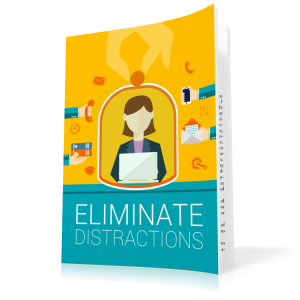 Eliminating Distractions is a 23 page (~6000 word) report that teaches you how to block distractions in key areas of your life.
Sections Include:
- Distraction – The Enemy Of Productivity
- Eliminating Distractions At Home
- Eliminating Distractions At Work
- Eliminating Technology Distractions
- Eliminating Social Distractions
- Eliminating Inner Distractions
- What You Can Do Right Now
- 10 Steps To Eliminate Distractions In Your Life